The Anthropic Export-Control Move Smells Funny
Opinion, with speculation clearly marked.
There are times when a policy decision may be defensible on paper but still smell wrong in context. The US government’s sudden move to restrict foreign-national access to Anthropic’s Fable 5 and Mythos 5 models is one of those moments.
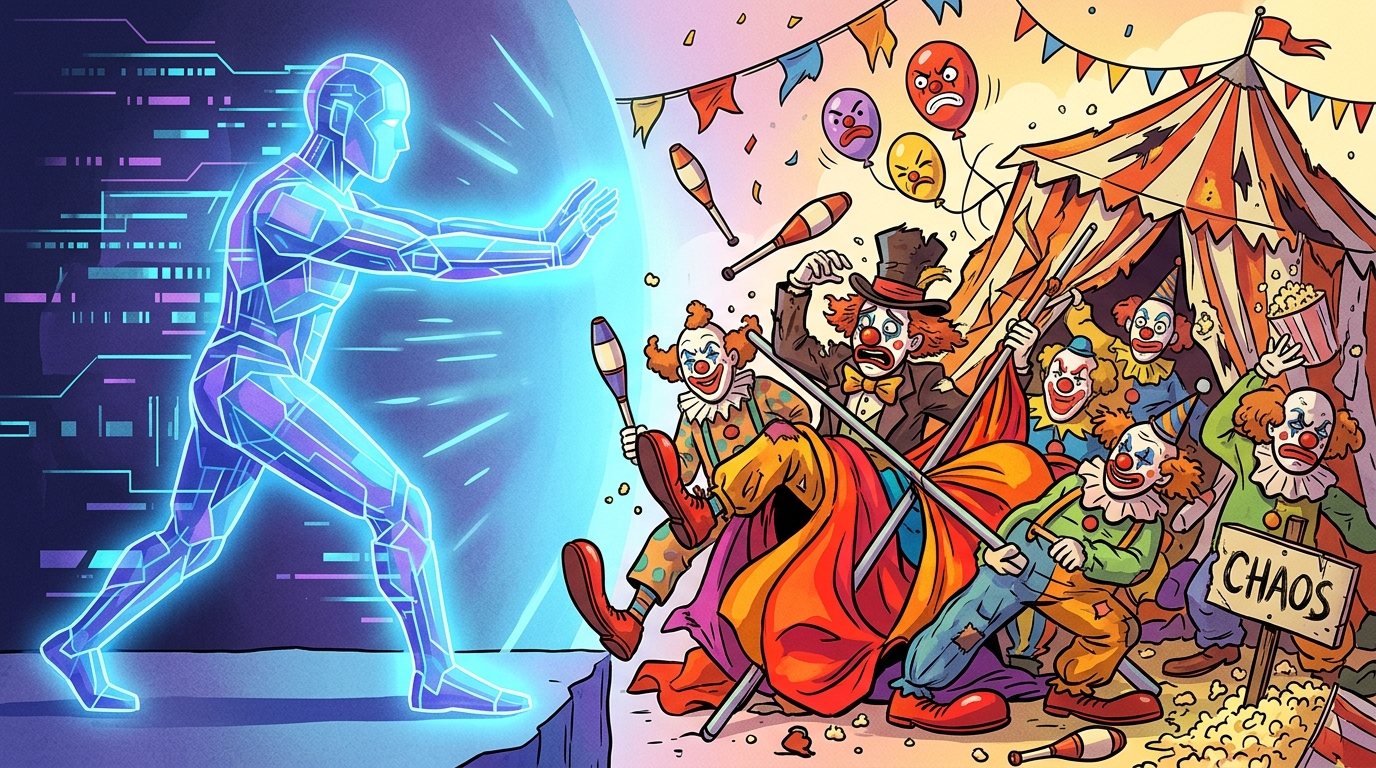
Not “a minor procedural irregularity” wrong. More like a clown with bad BO and cheap aftershave has just walked into the room and everyone is pretending not to notice.
To be clear at the start: there is not yet public evidence proving insider trading, market manipulation, or corrupt coordination. Those are serious claims, and they require trading records, communications, timing data, and legal process. But the timing, selectivity, and market context of this decision are ugly enough that they deserve proper scrutiny.
What happened
Anthropic says the US government issued an export-control directive requiring it to suspend access to Fable 5 and Mythos 5 by any foreign national, whether inside or outside the United States, including Anthropic’s own foreign-national employees. Because of the compliance burden, Anthropic said it had to disable those models for all customers.[1]
That alone is extraordinary. These are not missile components being shipped in crates. These are frontier AI models delivered as cloud services, used by developers, researchers, and companies around the world.
Anthropic says the directive was based on national-security authorities. It also says it disagrees with the order, and understands the concern to relate to possible jailbreaking of Fable 5.[2] Anthropic’s public position is that the demonstrated behaviour involved only a narrow class of previously known vulnerabilities, and that comparable capabilities are already widely available in other public frontier models.
That last part matters.
If the actual regulatory principle is “frontier AI models that can assist cyber work must be export-controlled”, then the rule should apply across the sector. If the rule is instead applied to one company, at one exquisitely market-sensitive moment, then the question changes from “is this good AI policy?” to “why this company, why this model, and why now?”
Timeline
Here is the part that makes the whole thing smell.
1 June 2026 — Anthropic confidentially files for IPO.
Reuters reported that Anthropic had confidentially filed for a US initial public offering, putting it ahead of OpenAI in the race to public markets.[3]
8 June 2026 — OpenAI confidentially files for IPO.
Reuters reported that OpenAI had also filed confidentially, with a possible public-market debut as early as September and a valuation target that could reach around $1 trillion.[4]
9 June 2026 — Anthropic makes Fable 5 more broadly available.
Anthropic released Fable 5, described as a safety-limited version related to its more capable Mythos model family. Reporting noted that Anthropic had previously restricted broader access because of cybersecurity concerns.[5]
12 June 2026 — SpaceX goes public.
SpaceX completed a record-setting IPO, widely reported as one of the largest public-market debuts ever.[6] The SpaceX story is not just rockets: reporting has tied the company’s public-market narrative to Starlink, X, and xAI exposure. It also landed in the same investor conversation as the forthcoming OpenAI and Anthropic listings.
13 June 2026 — Anthropic disables Fable 5 and Mythos 5 after US directive.
Anthropic announced that a US government directive had forced it to suspend access to Fable 5 and Mythos 5 by foreign nationals, with the practical effect of disabling the models for customers.[7]
That is an extraordinary sequence.
One AI-adjacent giant goes public. Two frontier AI companies are lining up public offerings. Then the government imposes a sudden, highly disruptive restriction on one of those AI companies’ flagship models, creating new uncertainty around revenue, compliance, global access, staffing, and model deployment.
You do not have to believe in a grand conspiracy to see why this deserves investigation.
Why the stated national-security rationale is not enough
There are real reasons to worry about frontier AI models. A genuinely capable model can help write code, analyse systems, chain together tools, discover vulnerabilities, generate biological hypotheses, and lower the skill barrier for dangerous work.
So, no, “national security” is not automatically nonsense.
But a serious national-security policy should be threshold-based, company-neutral, technically justified, and reviewable. If the concern is cyber uplift, then the government should explain the class of capability being controlled. If the concern is foreign access, it should explain why cloud access to this model is categorically different from access to other models with similar capability. If the concern is jailbreaking, it should explain why one company’s safeguards are uniquely insufficient.
Anthropic’s claim is that the issue identified by the government was not unique to Anthropic. If true, that is devastating to the fairness argument. If GPT-5.5, xAI models, or other frontier systems can perform similar tasks, then targeting Anthropic alone looks less like neutral export control and more like selective intervention.
And selective intervention, in a market this sensitive, is not a small thing.
Why this is market-moving
Export controls do not merely affect users. They affect valuations.
For a frontier AI company heading towards an IPO, investors care about growth, international revenue, enterprise adoption, regulatory risk, deployment stability, government relationships, talent access, and whether customers can trust that a flagship model will still be available next week.
The Anthropic directive hits several of those at once.
It creates uncertainty over whether Anthropic can serve non-US customers. It creates uncertainty over whether foreign-national employees can work on, test, or use the company’s most advanced systems. It creates uncertainty over whether Anthropic’s release strategy can survive political intervention. It creates uncertainty over whether customers should build production workflows on Anthropic’s newest models.
That is exactly the kind of thing that can change an IPO story.
Meanwhile, SpaceX had just gone public. Reporting has described its IPO approach as a model for Anthropic and OpenAI.[8] If one competitor in the AI IPO race is suddenly burdened with severe access restrictions, that can alter investor perception of the whole field. If another politically favoured ecosystem appears less burdened, that changes the relative story again.
This is why timing matters.
The Trump administration context
This would smell less bad in an administration with a pristine firewall between markets and policy. That is not the context here.
There has already been substantial scrutiny around market-moving Trump administration decisions and well-timed trades by officials or connected figures. Reporting has examined stock sales by officials before tariff announcements[9], unusual options activity around tariff pauses, and the sheer volume of securities transactions disclosed through President Trump’s own financial filings. Reuters has reported at least $220 million in disclosed securities transactions by Trump in the first quarter of 2026, with the total possible range much higher because ethics disclosures use broad bands.[10]
None of that proves wrongdoing in this Anthropic matter.
But it does establish a context in which “market-moving political decision lands at a suspiciously convenient time” is not an irrational concern. It is a pattern people are already primed to examine.
There is also a separate ethical issue: even if trades are handled through discretionary accounts or family-managed trusts, a sitting administration making sudden policy decisions that can move markets creates an obvious appearance problem. In a healthy system, the answer would be radical transparency, strict blind trusts, fast disclosure, and independent investigation. Without that, every abrupt market-sensitive intervention becomes suspect.
The stronger, fairer claim
The strongest version of the argument is not:
“This proves insider trading.”
It is:
“This is a market-moving intervention, affecting a pre-IPO frontier AI company, imposed immediately after a historic SpaceX IPO and shortly before expected OpenAI and Anthropic listings. Given prior concerns about politically connected trading around Trump administration market decisions, the timing and selectivity warrant investigation.”
That claim is hard to dismiss.
It does not require assuming that every official involved acted corruptly. It allows for genuine national-security concerns. It leaves room for classified evidence. But it also refuses to pretend that this is normal.
Questions investigators should ask
A serious investigation would not start with vibes. It would start with records.
Who knew the directive was coming, and when?
Was the directive discussed with White House officials, Commerce, Defense, intelligence agencies, campaign donors, investors, banks, or executives at competing companies?
Were any politically connected people or entities trading in AI-adjacent stocks, SpaceX-linked vehicles, pre-IPO funds, secondary-market shares, options, or structured products before the directive became public?
Did any underwriters, private banks, family offices, or political allies receive non-public guidance about AI export-control risk?
Why was Anthropic singled out?
Were OpenAI, xAI, Google, Meta, or other frontier-model providers assessed under the same standard?
If comparable capabilities exist elsewhere, what made Fable 5 and Mythos 5 uniquely export-controlled?
What appeal or review process exists for a model provider hit by such a directive?
And perhaps the biggest one:
Was this a genuine AI-safety policy, or was national security used as a convenient lever in a politically and financially sensitive market moment?
My view
My opinion is that the directive may have a real national-security component, but the timing and selectivity look rotten.
A competent, fair frontier-AI export-control regime would apply clear capability thresholds across all major labs. It would not look like a surprise kneecapping of one company’s flagship models immediately after a politically connected mega-IPO and before rival AI listings.
The insider-trading hypothesis is plausible enough to investigate, but not proven enough to state as fact. The market-favouritism hypothesis is stronger: a selective regulatory strike can benefit some actors and hurt others even without anyone placing an illegal trade.
That distinction matters. Corruption does not always need to look like a brown envelope or an options trade placed fifteen minutes before an announcement. Sometimes it looks like arbitrary state power applied unevenly, at just the right moment, while everyone with something to gain insists that it is merely policy.
Maybe the government has classified evidence that justifies the Anthropic action. Maybe Fable 5 and Mythos 5 really do cross a line that other models do not. Maybe this is a clumsy but sincere attempt to manage frontier-model risk.
But if that is the case, the government should be able to explain the threshold, apply it consistently, and tolerate scrutiny.
Until then, this smells funny.
And not subtly funny. Clown. Bad BO. Cheap aftershave. Standing far too close.
Anthropic’s own statement says the US government issued an export-control directive suspending all access to Fable 5 and Mythos 5 by foreign nationals, including foreign-national Anthropic employees, and that Anthropic disabled the models for customers to ensure compliance. https://www.anthropic.com/news/fable-mythos-access ↩︎
Business Insider reported that the order arrived by letter on a Friday evening, cited national-security concerns, covered foreign nationals regardless of location, and that Anthropic believed the issue related to a potential Fable 5 jailbreak. https://www.businessinsider.com/anthropic-disable-mythos-fable-us-export-control-national-security-2026-6 ↩︎
Reuters reported that Anthropic confidentially filed for a US IPO on 1 June 2026. https://www.reuters.com/business/ai-giant-anthropic-confidentially-files-us-ipo-2026-06-01/ ↩︎
Reuters reported that OpenAI filed for a US IPO after Anthropic, with a possible debut as early as September and a valuation target up to $1 trillion. https://www.reuters.com/technology/openai-files-us-ipo-after-anthropic-ai-giants-head-public-markets-2026-06-08/ ↩︎
The Guardian reported on 9 June that Anthropic had released a “safe” version of its Mythos-related model, Fable 5, while restricting sensitive uses. https://www.theguardian.com/technology/2026/jun/09/anthropic-claude-mythos-ai-model ↩︎
The Guardian reported SpaceX’s 12 June 2026 stock-market debut, including its large valuation jump and connection to the broader AI market narrative. https://www.theguardian.com/science/2026/jun/12/spacex-stock-price-ipo-spcx ↩︎
Reuters reported the same broad action: Anthropic disabled top-tier models after a US order limiting foreign access. https://www.reuters.com/technology/us-blocks-foreign-access-anthropics-most-advanced-ai-models-axios-reports-2026-06-13/ ↩︎
Axios described SpaceX’s IPO as a model for Anthropic and OpenAI, both of which were preparing public offerings. https://www.axios.com/2026/06/12/spacex-ipo-anthropic-openai ↩︎
ProPublica reported that US officials and congressional aides sold stocks before Trump tariff actions moved markets; officials denied or disputed having improper input or knowledge. https://www.propublica.org/article/us-officials-stock-sales-trump-tariffs https://www.propublica.org/article/sean-duffy-stock-sales-trump-tariffs ↩︎
Reuters reported that Trump disclosed at least $220 million in securities transactions in the first quarter of 2026, with the disclosed range potentially much higher because of broad reporting bands. https://www.reuters.com/legal/government/trump-ethics-filing-reveals-thousands-trades-tied-us-corporate-securities-2026-05-14/ ↩︎